A homeowners policy in Illinois does not pay for a power outage itself. It pays for what the outage caused inside your house, if the policy names that cause: a pipe that froze and split, the water that came out of it, a fire. A basement flooded because the sump pump lost power is a different case, and the standard form leaves it out unless you bought water backup coverage. Spoiled food usually needs its own endorsement too. The electric utility owes you money only under one Illinois statute, and a winter storm is exactly the kind of event that statute lets the utility ask to be excused from.
I am a public adjuster in Chicago, and after every ice storm I get the same call: the power was out for two days, and now there is water on the floor and a freezer full of food in the trash. The answers below come from the standard ISO homeowners form HO 00 03 05 11, which many Illinois carriers build on, from 220 ILCS 5/16-125, and from the 2014 appellate decision that applied it to the 2011 storms. Your own policy may be worded differently, so read it next to this.
Why does it matter where the power failed?
Because the policy excludes a failure that happens off your property, and then lets back in whatever covered damage it causes at home. The exclusion is short. It does not say outages are covered or not covered in general; it sends you looking for a second cause on your own premises.
The utility's lines
Ice brings down a feeder three blocks away, or a substation trips. This is off the residence premises.Equipment on your property
If the failure starts here, the off-premises exclusion does not apply by its own words. Where your property ends on the service line is a fact to pin down with photos.Inside the house
Heat stops, pipes freeze and split, the sump stops, the refrigerator warms. The policy asks whether a peril it insures happened here.Power Failure means the failure of power or other utility service if the failure takes place off the "residence premises". But if the failure results in a loss, from a Peril Insured Against on the "residence premises", we will pay for the loss caused by that peril.
ISO HO 00 03 05 11, Section I, Exclusion A.4 (copy published by the Maine Bureau of Insurance)
Freezing is the peril that most often comes back in through that second sentence. The same form insures freezing of a plumbing or heating system only if you used reasonable care to maintain heat in the building, or to shut off the water supply and drain the systems. When the furnace has no power for two days, the first option may be out of your hands. The second one is still open, and the adjuster will ask whether you took it.
Which outage losses does a home policy pay?
Some of them, under different parts of the policy, and a few under no part at all. I sort an outage file loss by loss before anything is reported, because a single claim number often mixes a covered pipe with an excluded basement.
| Loss | Who usually pays | The wording that decides it |
|---|---|---|
| Pipe froze and split while the heat was off | Home policy | Freezing, with the reasonable care condition: heat maintained, or water shut off and drained. |
| Water from that pipe across floors and drywall | Home policy | Accidental discharge, including tearing out the part of the building needed to reach the pipe. The pipe itself is not paid. |
| Basement flooded because the sump pump stopped | Endorsement | Exclusion A.3.b removes water discharged from a sump. Water backup and sump overflow coverage, bought separately, puts it back up to its own limit. |
| Food in the refrigerator and freezer | Endorsement | The base form has no line for it. Refrigerated property coverage (ISO form HO 04 98) is the usual add-on; one carrier's guide describes it as up to $500 with a $100 deductible. |
| Hotel while the house was cold but undamaged | Usually nobody | Loss of use starts when a covered loss makes the home not fit to live in. An outage with no covered damage rarely meets that. |
| Hotel after the pipe flooded the first floor | Home policy | Additional living expense, because a covered loss now makes the house unfit. |
| Electronics burned when the power came back | Depends | For contents, the form's electrical current peril leaves out electronic components and circuitry. A separate section of the Illinois statute covers surges (below). |
| Ice and snow collapse part of the roof | Home policy | Not an outage loss at all; the form reads it under its weight of ice, snow or sleet wording, and the snow load page covers it. |
Each row has more detail than a table can carry. The pipe rows are where most of the money sits, and I have written about them twice: a house left empty in an Illinois winter, where the heat question is sharper, and the frozen pipe claims page for an occupied house. The sump row is the one owners argue about most, and the sewer backup page covers what the endorsement pays and what it does not.
When does the electric company have to pay for an outage?
Only when a large outage meets the conditions in 220 ILCS 5/16-125(e), and the Illinois Commerce Commission does not excuse the utility. Subsection (k) limits it to an electric public utility with 100,000 or more customers; ComEd, the utility in the 2011 case below, is one.
The utility can ask for a waiver if it shows the interruption came from unpreventable damage due to weather events or conditions, customer tampering, unpreventable damage from civil unrest or animals, or damage or actions by someone other than the utility and its contractors. While a waiver request is pending, the statute says the utility is not liable. A separate subsection, (f), covers surges and fluctuations affecting the same number of customers: the utility pays the replacement value of damaged goods, with the same four excuses available.
Two 2011 storms the Commission decided differently
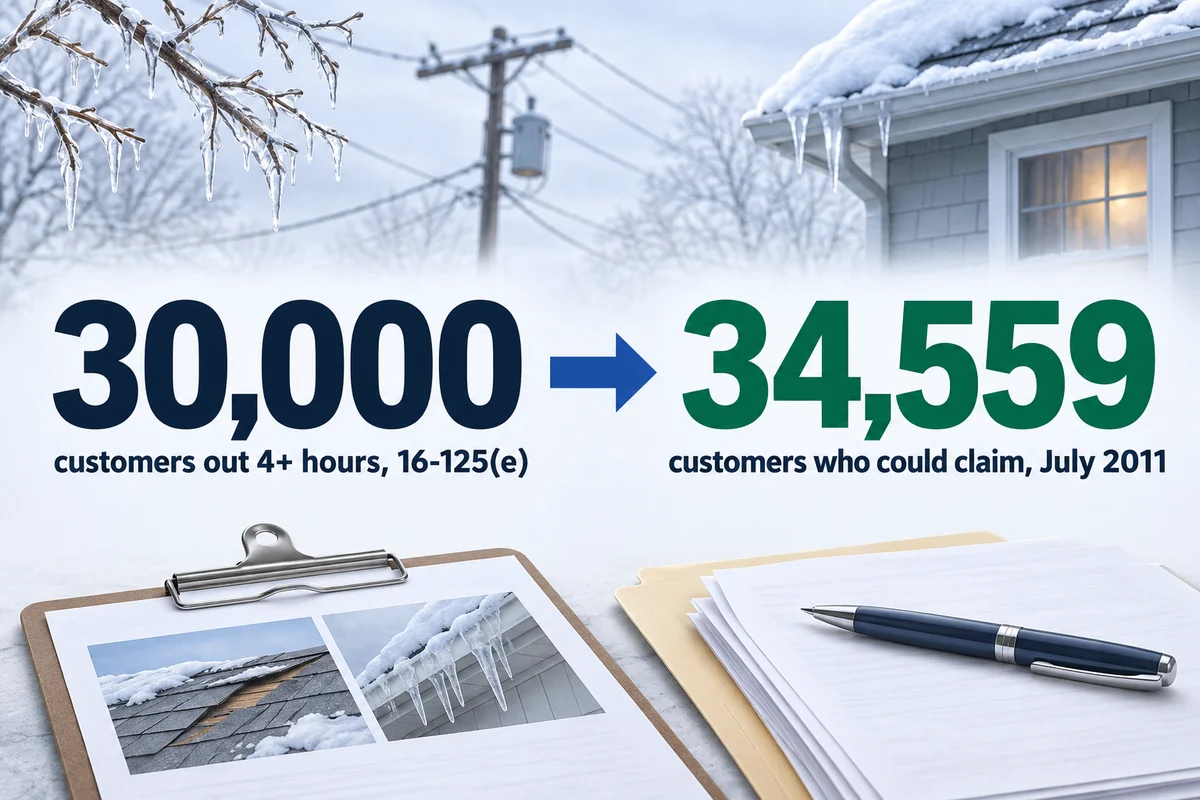
The clearest Illinois test of the statute is 2014 IL App (1st) 132011, decided July 31, 2014. More than 2 million of the utility's customers lost power in seven storms that year. The Commission read the statute to apply when 30,000 or more customers are interrupted during the same four-hour period, and the appellate court accepted that reading as reasonable. The waiver is where the two seasons split.
February 1, 2011: the winter storm
- Docket
- ICC No. 11-0662
- What the Commission found
- The great majority of interruptions came from unpreventable damage due to weather, so the utility got the waiver.
- On appeal
- The appeal from this order was dismissed.
July 11, 2011: a summer storm
- Docket
- ICC No. 11-0588
- What the Commission found
- No waiver for this storm. The 34,559 affected customers, and their municipalities, were entitled to file for compensation, and the utility had to send them written notice.
- On appeal
- Affirmed.
For a homeowner the lesson is practical. After a heavy ice or snow storm, expect the utility to argue the weather excuse, and expect the Commission to weigh evidence you will not see. A utility claim can still be worth filing for an outage caused by equipment failure on a calm day. For a storm, your own policy is usually the faster and surer route for anything it covers.
Illustrative: one outage, three payers
A worked example, every figure illustrative. A house in a western suburb is without power for 41 hours after an ice storm. A first-floor supply line freezes and splits, the sump stops and the basement takes water, and the freezer is lost. The owner has a $1,000 deductible, water backup coverage with a $5,000 limit, and no refrigerated property endorsement.
| Loss | Cost | Paid under | Paid |
|---|---|---|---|
| Drying, drywall, flooring, tear-out to reach the pipe | $9,400 | Freezing and accidental discharge, less the $1,000 deductible | $8,400 |
| Plumber's repair of the split pipe itself | $380 | Not paid: the system the water escaped from | $0 |
| Basement carpet, pad and lower drywall from the sump | $6,200 | Water backup endorsement, capped at its limit | $5,000 |
| Freezer and refrigerator food | $450 | No endorsement; a utility claim only if 16-125 applies and no waiver is granted | $0 |
| Total | $16,430 | Out of pocket in this example: $3,030 | $13,400 |
Two details in that file change real outcomes. Whether one deductible or two applies depends on whether the carrier treats the pipe and the sump as one loss; the ISO form says that when two or more deductibles apply to a loss, only the highest is used. And the $5,000 sump limit is a choice made at renewal, often years before the storm. If your declarations page shows a low figure, that is worth a call to your agent this month, not after the next storm.
What to do while the house is cold
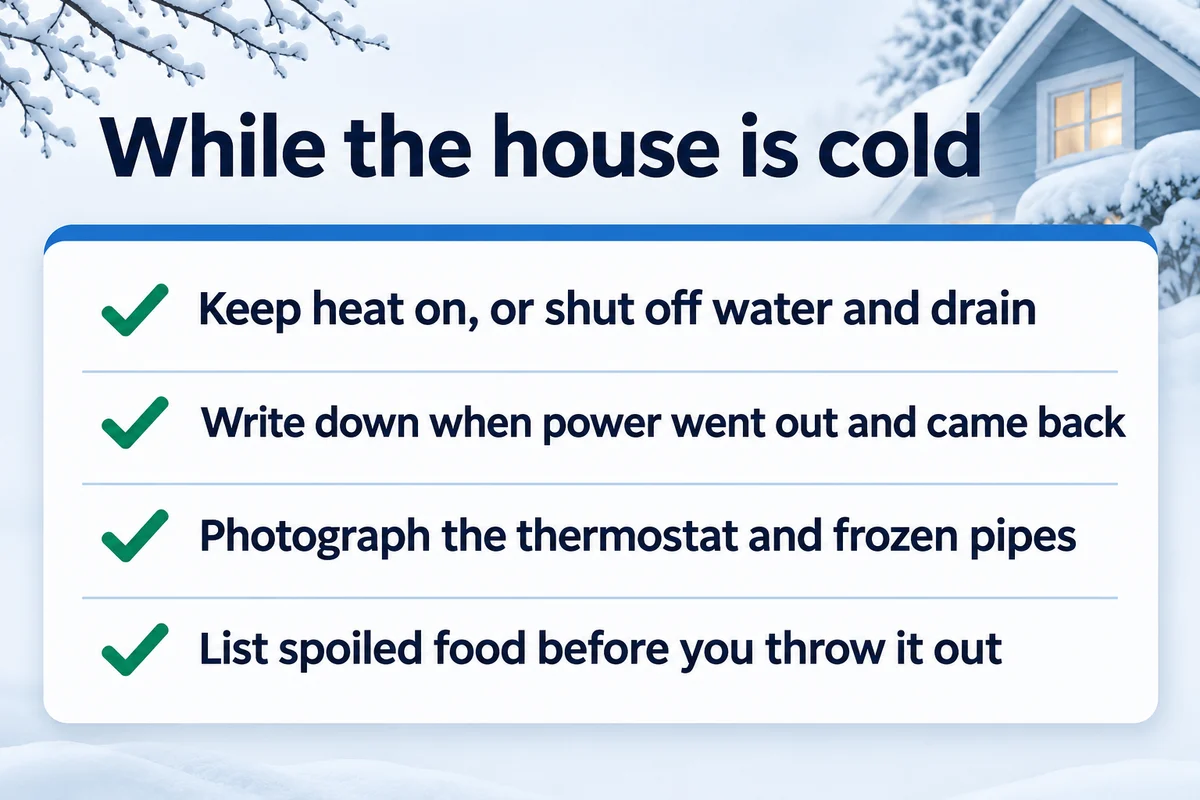
- If you cannot keep heat in the house, shut off the main water valve and open the lowest faucets to drain the lines. That is the second branch of the reasonable care condition, and it is the one still in your control during an outage.
- Write down the time the power went out and the time it came back. Save the utility's outage texts or screenshots of its outage map; they date the event without argument.
- Photograph the thermostat reading, frost on pipes, and any space heater or generator you ran, with the time on the photo.
- If water appears, turn off the supply, photograph it before cleanup, and start drying. The policy expects you to protect the property from further damage and to keep a record of what that cost.
- Before you throw out food, photograph the open freezer and the refrigerator shelves, and list items with rough prices.
- Check the declarations page for water backup and refrigerated property coverage before you decide what to report.
- Give your carrier prompt notice of the pipe and water damage. A late report hands the adjuster a question you do not need.
When a public adjuster helps, and when it is the Commission or a lawyer
If the outage cost you a freezer of food and nothing else, you do not need me, and a claim under your deductible may not be worth filing at all. Where a public adjuster earns a fee is the frozen pipe file that spreads through two floors, the estimate that prices drywall but forgets the tear-out, and the file where the carrier tries to put pipe damage under the sump endorsement's lower limit. I handle those through my water damage claims work in Illinois and Indiana, and the first conversation costs nothing.
A claim against the utility under 16-125 is not something I file. It goes through the Illinois Commerce Commission, and a dispute over a waiver, or a lawsuit about an outage, is a legal question for an attorney. If you want me to look at your policy and the damage first, send me the declarations page and a few photos.