A commercial theft claim in Illinois is normally covered when an outsider takes your property and your policy uses the Special causes of loss form. That same form then takes three situations back out: theft by your own people, property handed over because of a trick, and stock that is simply missing with nothing but a count to show for it. So two questions decide the file. Who took it, and what do you have apart from the inventory sheet?
The wording below comes from the standard ISO forms, and I work as a licensed public adjuster for policyholders in Illinois (#19461872) and Indiana (#3556317). Many carriers print their own version, so hold your policy next to this article and compare the sentences. I am not a lawyer. Where the argument becomes what a clause legally means, or a person is about to be accused of a crime, that belongs with an attorney.
Does the policy pay? It depends on who took the property
Start with the person, even if you only have a suspicion. Form CP 10 30 10 12 treats each of these differently, and a crime policy, if you bought one, picks up some of what the property form drops. The standard wording sorts them this way:
| Who took it | Standard property form | What to do with that |
|---|---|---|
| A burglar who forced a door, window or roof hatch | Covered, subject to the limits and conditions further down this page. | Report it and prove the amount. This is the simplest version of the claim. |
| A shoplifter or a thief nobody saw | Theft is covered, but limitation C.1.e applies if nothing physical shows what happened. | Look for video, a tag on the floor, a witness, a police report on the incident. |
| An employee, partner, officer, manager or leased worker | Excluded by paragraph B.2.h, "whether acting alone or in collusion". Their acts of destruction are still covered. | Read your commercial crime policy or employee theft coverage. Call an attorney before you accuse anyone. |
| Someone you trusted with the property, such as a repair shop or a person borrowing a van | Paragraph h also reaches "theft by any person to whom you entrust the property for any purpose". | Gather the paperwork that shows how the property came to be with them, and show it to an attorney. |
| A caller or fake driver who talked your staff into releasing goods | Paragraph B.2.i excludes voluntary parting induced by a "fraudulent scheme, trick, device or false pretense". C.1.f limits transfers on unauthorized instructions. | Check the crime policy for fraud coverage and keep every email and bill of lading. |
What does the policy say about stock that is only missing?
One sentence causes most of the trouble, and an insurer's denial letter will usually quote it or a close cousin. It sits among the limitations of the Special form:
"Property that is missing, where the only evidence of the loss or damage is a shortage disclosed on taking inventory, or other instances where there is no physical evidence to show what happened to the property."
On a property policy, the sentence asks about evidence
The important word is "only". A count that shows a shortage is not forbidden. It just can't stand alone, and the form asks for something physical beside it.
On a crime policy, a similar clause asks about the computation
Older crime forms exclude a loss whose proof "as to its existence or amount" depends on an inventory or profit and loss computation. A 2002 ISO crime form, quoted in a paper by D.M. Studler and Dolores Parr, adds that once you establish a loss "wholly apart from such computations", you may offer inventory records and a physical count to support the amount. Your edition may differ, so read the one you hold.
Put plainly, on both forms the shortage can't be your whole case, though the count can still measure the amount once something else has shown a loss. Courts in other states have split on how far this goes, and how an Illinois court would treat your exact sentence is a question for an attorney.
Which proof gets a shortage past that sentence?
Proof that the theft happened and proof of how much was taken are separate jobs, and a claim needs both. I would rank what a business usually has this way, strongest first:
A forced door, cut fence, broken lock or smashed case, photographed before it is repaired, with a police report made at the time.
Shows it happenedCamera footage or an alarm log with a date and time, showing the goods leaving or someone inside when nobody should be.
Shows it happened, sometimes how muchSerial numbers or item tags for particular units that were recorded on the premises and are now gone or turning up for resale.
Shows it happened and how muchItem-level count sheets from two dates, plus receiving and sales records for the same items between them.
Shows how muchA dollar gap between the books and a physical count, with no item detail. This is the proof the sentence is written to refuse.
Shows a difference only
The difference between the fourth rung and the fifth has mattered in court. The Studler and Parr paper reports a 1996 federal decision from the Northern District of Illinois (1996 WL 308233), on a crime policy, that read the exclusion as reaching estimates built from dollar figures but not a loss shown by a particular item identified at one physical count and absent at the next. It also reports a Tennessee appellate decision that treated items shown as received, missing and not sold as outside an inventory computation. Those are other policies and other facts, and neither promises you anything. They do show why a count by item is worth the extra days it takes.
What one Illinois court file shows about slow losses
Illinois Appellate Court, First District, No. 1-98-0701 (1999)
A service company kept freon canisters in a locked, fenced cage. In May 1993 its count did not match its ledger, and it concluded that 439 canisters worth about $83,500 had gone. It claimed under the employee dishonesty coverage of a crime policy with a $10,000 deductible for each occurrence. The court's opinion shows a manager's analysis of purchase orders and requisition forms, testimony about who held keys, and a rumor about one serviceman.
The owner lost, and the reason is worth noticing. The court did not decide whether the count fell inside the inventory exclusion, and it remarked that Illinois authority on the point is sparse. It assumed the loss was employee dishonesty and still affirmed, because nothing showed how many occurrences there were or which of them, if any, went over the deductible.
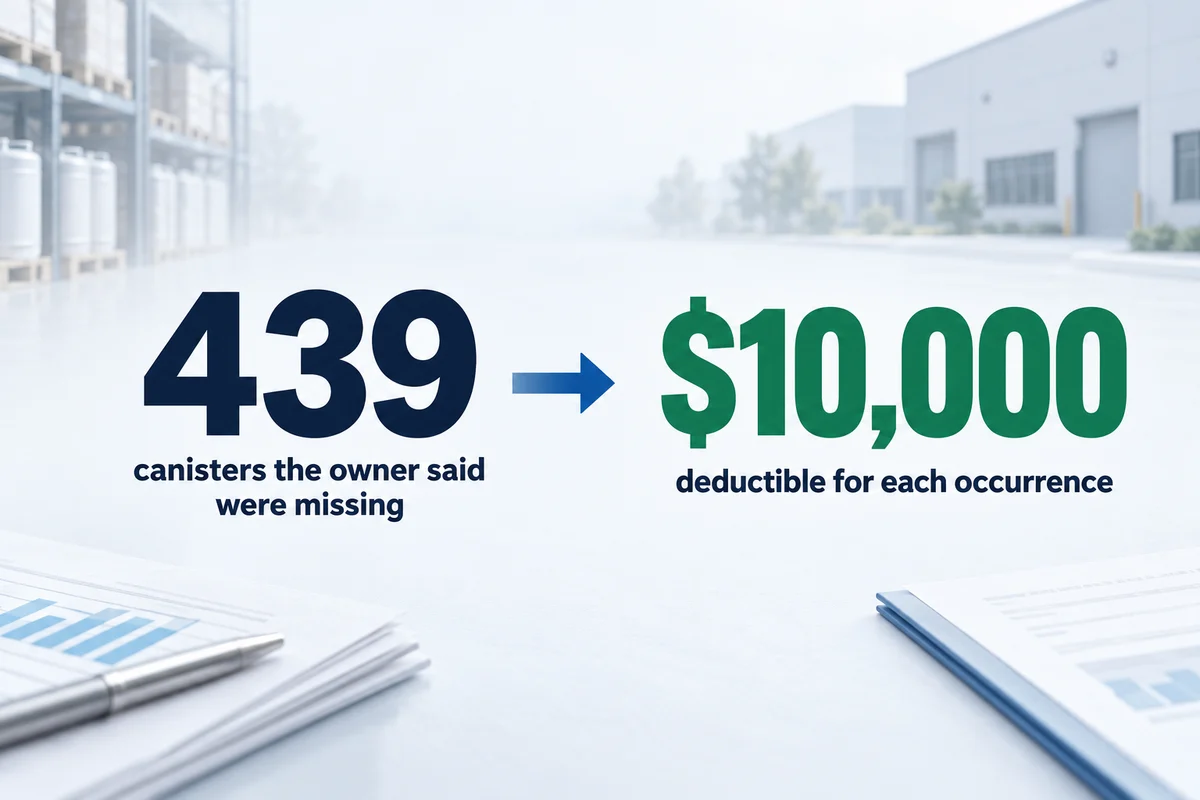
For a business owner the practical point is dates. Forty small thefts over a year can fall under forty deductibles, and a loss spread evenly over an unknown number of events may not be provable at all under that kind of wording. Before you file, look for what ties the loss to particular days: the week the count last agreed, the shift a pallet disappeared, the night the alarm tripped. Read how your policy defines an occurrence, and whether it treats a series of related acts as one.
How do I count what was taken?
By item, between two dates you can defend, starting from the last count you trust. Add what was received, take off what was sold, and compare that with what is on the shelf now. The sheet below is made up to show the method (an illustrative worked example): a tool supplier whose rear door was forced three weeks after a full count.
| Item | Last count | Received | Sold | Counted now | Missing | Unit cost | Value |
|---|---|---|---|---|---|---|---|
| Hammer drills | 40 | 24 | 38 | 4 | 22 | $129 | $2,838 |
| Copper wire spools | 60 | 30 | 52 | 11 | 27 | $84 | $2,268 |
| Cordless nailers | 12 | 6 | 9 | 1 | 8 | $310 | $2,480 |
| Test meters | 25 | 10 | 20 | 3 | 12 | $96 | $1,152 |
| Total at cost | 69 | $8,738 |
All numbers in this illustrative sheet are invented. Expected on hand is last count plus received less sold, and missing is expected less counted now. A $1,000 deductible, also illustrative, would leave $7,738 before any valuation change.
Expect the adjuster to ask what your ordinary shrink runs at, because a shortage that looks like every other quarter does not point to one night. That is also why the forced door has to sit beside this sheet: on its own the sheet is an inventory computation, and with the door it measures a loss that already has its proof. The same care over records helps in any contents claim, and I wrote about rebuilding them in documenting contents without a receipt for anything.
Check how the stock is valued before you add up your figures. The standard building and personal property form (CP 00 10 10 12) values property at actual cash value, and its Replacement Cost option leaves out stock unless the declarations show the Including "Stock" option. Stock already sold but not delivered is valued at the selling price, less discounts and expenses you would otherwise have had.
Five clauses that can stop or shrink a theft payment
The form named on the declarations
The Basic and Broad forms list their perils, and theft is not on the list. If your declarations do not say Special, read that first.
Dollar caps on furs, jewelry and tickets
For any one theft, the form sets $2,500 for furs, $2,500 for jewelry, watches, gold and similar metals (items worth $100 or less are outside it), $2,500 for patterns, dies and molds, and $250 for stamps, tickets, lottery tickets and letters of credit, unless your declarations show more.
An alarm the policy requires
Endorsement CP 12 11 removes theft cover if you knew the listed alarm or guard service was impaired and did not tell the insurer, or failed to keep it working where you had control of it. Pull the alarm company's service log now.
A building empty for over 60 days
The Vacancy condition in CP 00 10 takes theft and attempted theft out when the building has been vacant for more than 60 consecutive days before the loss. Buildings under construction or renovation are not considered vacant, and a tenant's test differs from an owner's.
A theft exclusion added by endorsement
CP 10 33 removes theft at the premises it lists, while leaving building damage from burglars breaking in or out. Underwriters tend to use it for vacant buildings and stock prone to theft, so check your forms list for that number.
What should I do in the first two days?
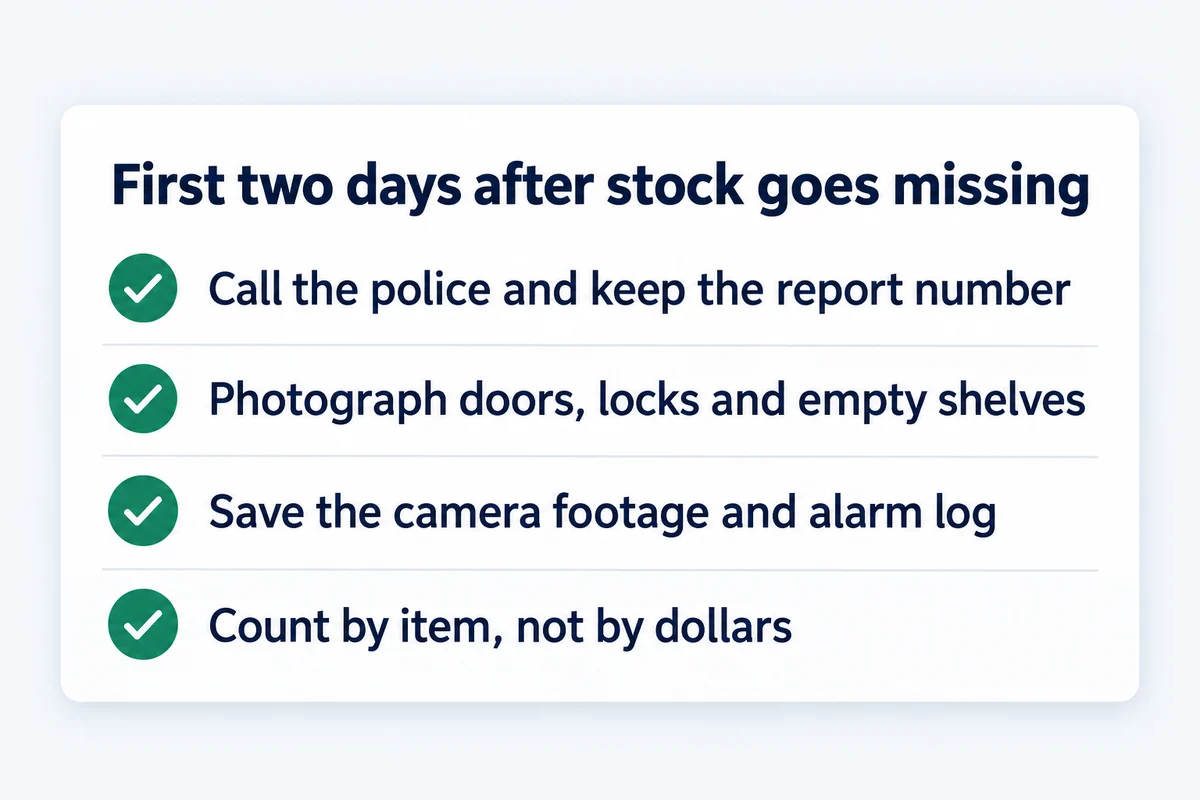
Report it, freeze the scene and start the item count before anything is tidied. In the order I would work:
- Call the police the day you find it, and write down the report number and the officer's name. The form's duties after a loss list this first: "Notify the police if a law may have been broken."
- Photograph the door, lock, frame, fence, empty shelves and any tracks or dropped goods before a locksmith arrives. Keep the broken lock.
- Ask your camera and alarm vendors to save footage and logs today, since many systems record over themselves.
- Notify the insurer in writing with a short factual description. Leave out your theory of who did it.
- Secure the opening and keep the invoice, because the form also asks you to protect the property from further damage.
- Freeze receiving and sales for the items involved long enough to count them, and keep the original sheets with who counted and when.
- If you suspect someone on your staff, speak with an attorney before you question or fire them, and check the notice terms of your crime policy.
You may be asked for a sworn proof of loss, so don't sign a total you can't support line by line. If a break-in shut you down, the closed days are a separate question, covered in my post on business income after a loss.
Who should look at the file: an adjuster, an accountant or a lawyer?
It depends on what is in dispute. A disagreement over how many units, what they were worth, or a broken door and frame priced too low is a measuring question, and a public adjuster can work on it. Records that need reconstructing are often a job for your accountant too. A denial built on who stole the goods or on the meaning of the inventory sentence, or any suggestion that you staged the loss, belongs with an attorney, and an insurer's request for an examination under oath is a good moment to call one.
You can leave me out when the door was forced, the items are listed, the amount is small against the deductible or the insurer has already paid your count. Otherwise, the commercial property claims page describes how I work with businesses, and you can send the letter, the forms list and your sheets through the contact page for a free first conversation. Nobody honest can tell you in advance what an insurer will pay on a missing-stock file.