A septic backup into the house is two claims that people treat as one. The sewage on your floor, the wet drywall and the ruined carpet are damage to the house, and on most Illinois homeowners policies that damage is paid only if you bought a water backup endorsement, up to the limit printed on it. The tank, the pipes and the drain field in the yard are a second question, and when they fail from age, roots or a tank that was not pumped, the policy usually pays nothing for them. Which way your claim goes depends on what backed the system up, and the person who can prove that is the pumper who opens the tank.
Below I walk the path the waste takes from your toilet to the field, quote the policy wording that reads each part, and list the papers that decide the cause. The policy quotes are from the standard homeowners form most Illinois policies are built on; your own carrier's wording can differ, so use them to find the same clause in yours.
Does homeowners insurance cover a septic backup into the house?
Usually only through the backup endorsement, because the base policy excludes water that backs up through drains. What the endorsement pays is the damage inside the house. What it does not pay for is the septic system itself. Follow the waste out of the house and you can see where one question ends and the other starts.
Floors, walls and belongings in the house
Sewage comes up through the lowest fixture, usually a basement shower drain, a floor drain or a toilet. Everything it soaks is house damage.
Read under: the water backup endorsement and its limitThe building drain and the line out to the tank
A pipe under the slab or in the yard. If it cracked or a root got into a joint, the pipe itself is a repair the policy usually leaves out as wear and tear.
Read under: wear and tear, unless a covered event broke itThe septic tank and its baffles
A full tank, a collapsed inlet or outlet baffle, or a tank that cracked. The tank is the system the water came from, and the policy does not pay to fix that system when it simply wore out.
Read under: the tank repair is a separate line from the houseThe distribution box and the drain field
When the field is clogged or saturated, the tank has nowhere to send water and it rises back toward the house.
Read under: maintenance and wear, or ground water after heavy rainThe pump and float on an alternative system
Aerobic units and systems with a dosing pump have electrical parts. A pump that stopped is a mechanical breakdown, not a covered event in the base form.
Read under: mechanical breakdown, unless your endorsement names it
Stop 1 is the claim most owners can make. Stops 2 to 5 are where the cause is decided, and that cause can affect stop 1 too.
The usual exception is a sudden, outside event that breaks the system: a truck that crushes the tank lid, a tree that falls in a storm and splits the line, lightning that kills the pump. Those can be paid under the part of your policy that covers the structure the system belongs to, which your declarations page and form decide. Roots growing into a pipe over years are not that kind of event.
What the policy wording says about backup and the tank
Three short passages decide most septic files. I read them from the copy of ISO HO 00 03 05 11 published by the Maine Bureau of Insurance.
"Water which: (1) Backs up through sewers or drains; or (2) Overflows or is otherwise discharged from a sump, sump pump or related equipment"
Section I Exclusions, A.3.b. This is the line the backup endorsement buys back."We do not cover loss to the system or appliance from which this water or steam escaped."
Section I Perils Insured Against, exception to c.(6). The tank and its pipes are the system."Wear and tear, marring, deterioration"
Section I Perils Insured Against, A.2.c.(6)(a). The most common reason a tank or field repair is refused.One more point belongs here, because owners find it online. Lawyers have argued in courts outside Illinois that a septic system sitting entirely on your own lot is not a "sewer" in the sense of that exclusion, so the base policy should pay. I have not found an Illinois appellate decision on a septic tank, and how a court here would read your wording is a legal question. If your claim turns on it, that is the point to talk to a lawyer, not to me.
What backed it up decides the claim, so get it in writing
An adjuster will ask why the system backed up before asking what it damaged. The answer is in the tank, and it is visible only for the hour the lid is off. A licensed pumper who writes down what they saw gives you evidence you cannot recreate after the tank is pumped and closed.
| What backed it up | What the adjuster will read into it | What to get in writing |
|---|---|---|
| Tank full of sludge and scum | Lack of maintenance | Sludge and scum levels at this visit, plus your pumping receipts for the last several years |
| Collapsed inlet or outlet baffle | Deterioration of the tank | Which baffle, its material and condition, photos before it is replaced |
| Roots in the line or the tank | Gradual damage, not one event | Where the roots entered, and whether a tree fell or a line broke in a storm |
| Field saturated after days of rain | Ground water or surface water | Rain totals for the week, standing water over the field, tank level before and after pumping |
| Dosing pump or float stopped | Mechanical breakdown | The technician's finding on the pump, and whether a power cut or storm came first |
The pumping receipts matter more on septic than anywhere else, because "you did not maintain it" is the answer an owner hears most. The US EPA's guidance on caring for a septic system says an average household system should be inspected at least every three years and that household tanks are typically pumped every three to five years. Receipts that show you kept to that are the plainest reply to a maintenance denial. If a heavy storm is the cause you suspect, the sorting of surface water from backup that I explain in water damage vs flood applies to a septic house the same way.
How a backup limit meets a finished lower level
On most septic claims the endorsement limit, not the damage, sets the cheque. The worked example below is illustrative: a ranch house with a finished lower level, a $10,000 backup limit and a $1,000 deductible. Endorsements word the order of limit and deductible their own way, so read yours.
- Sewage extraction, cleaning and drying
- $3,400
- Drywall and insulation cut to two feet
- $2,900
- Vinyl plank flooring and base
- $4,100
- Belongings stored on the lower level
- $2,300
- House damage before the deductible
- $12,700
- Less the $1,000 deductible
- $11,700
- Paid, capped at the $10,000 backup limit
- $10,000
- Pumping and a new outlet baffle (worn out)
- $1,130 not paid
Worked example. Every figure is illustrative and is not a typical settlement.
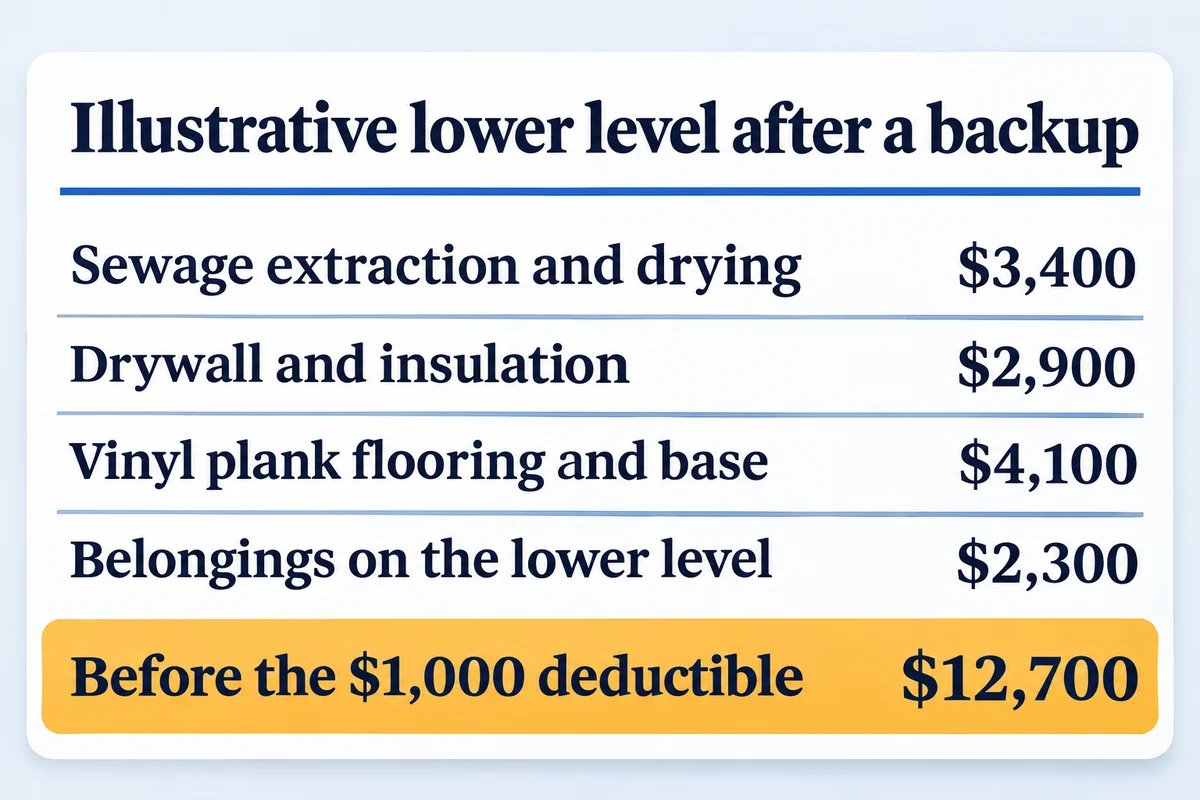
Two things change that picture. A sewage loss often brings mould, and many policies cap mould at a small sum; an estimate that names the sewage as the cause line by line keeps the cleaning under the backup coverage, which is how I write it on the sewer and drain backup claims page. And the drying bill is often the largest single line, so it needs its own daily log, as I explain in the drying bill after a water leak.
If the tank or field has to be replaced in Illinois
Septic repairs in Illinois run under the Private Sewage Disposal Code, and its section 905.190 sets three rules that also shape your paperwork.
- A replaced tank counts as a new system
- So does adding or removing a major component, or replacing 25% or more of the absorption field. A new system needs plan approval from the Department of Public Health or the local authority before work starts.
- 48 hours' notice for any repair
- Whoever constructs, installs, repairs or modifies the system has to notify the Department or the local authority at least 48 hours before the work begins.
- Covered too early, dug up again
- Work backfilled without meeting those rules has to be uncovered so it can be seen. A delay of that kind is worth knowing about before you plan how long the house will be out of use.
The permit file, the plan and the installer's notes are a written record of what failed in the system. Keep copies with the claim, whether or not the tank repair itself is covered. In Indiana, where I am also licensed, the rules come from that state and its county health departments, so ask the local office.
The first two days after sewage comes up
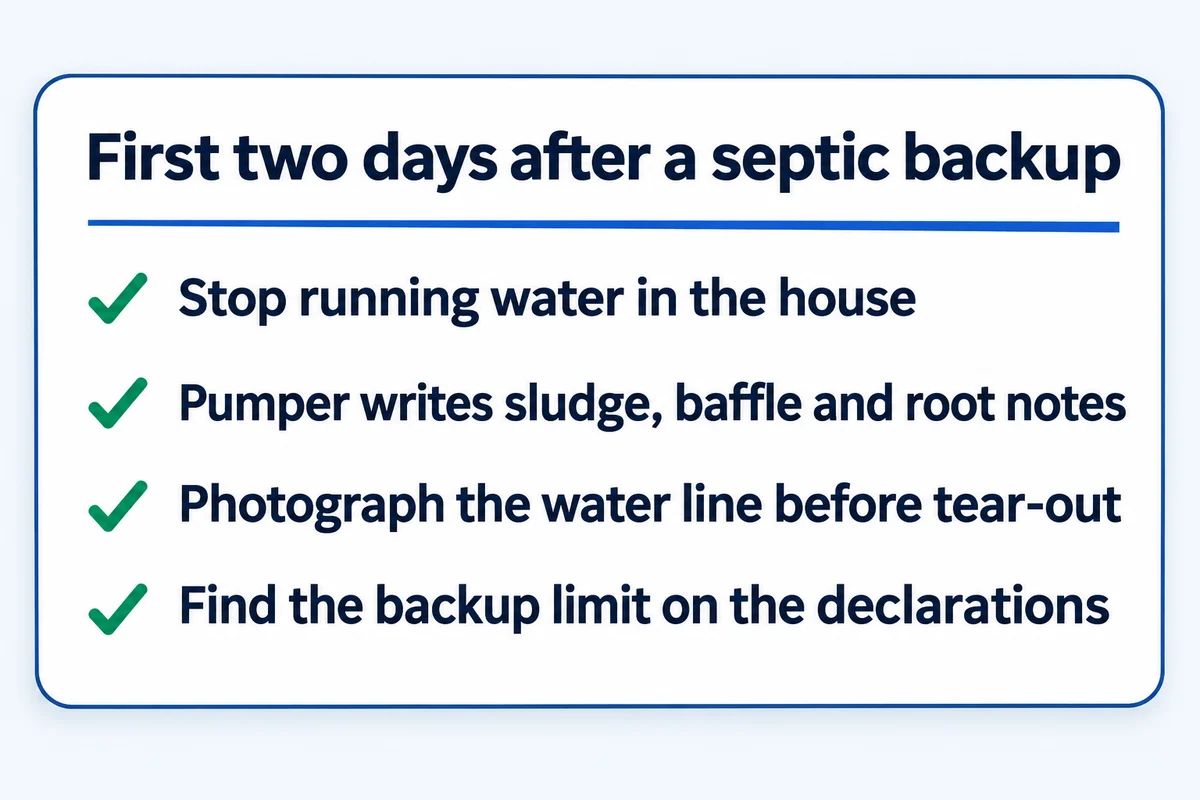
- Stop running water: no laundry, no dishwasher, no showers. Every gallon has to go somewhere, and the lowest drain is where it goes.
- Call a licensed pumper and ask them to write down the sludge and scum levels, the state of both baffles, any roots, and whether the field was holding water.
- Photograph the water line on every wall against a tape measure before anything is cut out.
- Report the loss to your insurer and ask for the claim number. Say what you saw, and leave the cause to the evidence.
- Find the backup endorsement and its limit on your declarations page. Illinois now requires insurers to send backup coverage information before each renewal, so the number may also be in that mail.
- Keep failed parts, such as a baffle or a pump, until the adjuster has seen them.
- Gather your pumping and inspection receipts in one folder.
When you do not need a public adjuster for this
If the damage is one small room, the endorsement limit covers it with room to spare and the adjuster accepts the cause, you do not need me. Send the pumper's note, the photos and the estimate yourself. I am useful when the loss is larger than the limit and every line has to sit under the right cause, when the carrier calls a backup maintenance and you have the receipts to answer it, or when a storm, a pipe break and a backup arrived together. Where the dispute is about what the policy means, a lawyer is the right person.
I am a licensed public adjuster in Illinois (#19461872) and Indiana (#3556317) and a licensed general contractor, so I write the repair scope myself, for the owner and never the insurer. If you want me to read your declarations page and the pumper's note first, send them to me; the office is open seven days a week.